
Why Bengaluru's Waste Problem
Starts With a Map
Bengaluru generates nearly 5,000 tonnes of solid waste every day — and ranked among the dirtiest cities in India in 2025. The gap between effort and outcome is a planning failure hiding in plain sight.
Bengaluru generates nearly 5,000 tonnes of solid waste every day. It has over 20,000 pourakarmikas on the streets. It spends significant public money on collection contracts every year. And yet it ranked among the dirtiest cities in India in the 2025 Swachh Survekshan. The gap between effort and outcome is not a mystery — it is a planning failure hiding in plain sight.
Key figures to note: Bengaluru generates nearly 5,000 T of solid waste daily, managed by over 20,000+ pourakarmikas on the streets. Despite these massive numbers and efforts, in the 2025 Swachh Survekshan, Bengaluru ranked among the dirtiest cities in India.
The Problem
A system designed around uniformity
The city's waste collection system is designed around uniformity. Contracts cover entire wards or large zones with a single set of instructions: collect, transport, deposit. There is no differentiation by road width, building type, waste generation rate, or vehicle suitability.
A narrow residential lane in a dense mixed-use neighbourhood is treated identically to a wide commercial arterial. A cluster of restaurants producing predominantly wet waste gets the same collection logic as a quiet apartment block.
The result is predictable: persistent black spots, waste accumulating on footpaths, open burning along roadsides, and dumping into stormwater drains — not because people don't care, but because the system isn't designed for the actual ground it operates on.
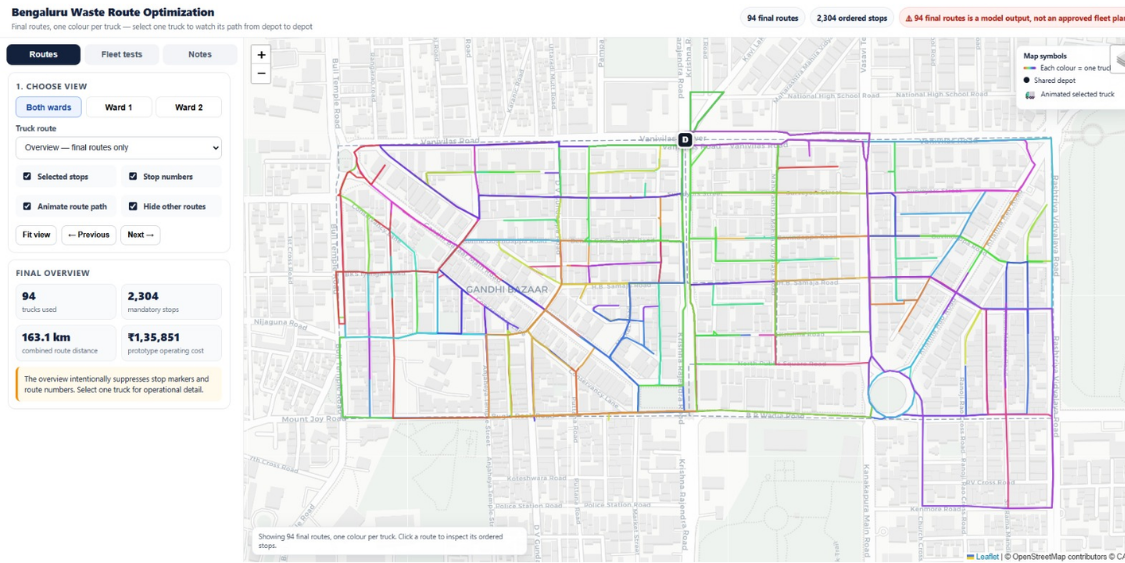
The first step to fixing this is not a new app, a new vehicle fleet, or a new awareness campaign. It is intelligence. Specifically, ward-level spatial intelligence — accurate, ground-truthed information about who generates what kind of waste, where, in what quantities, and what it takes to physically reach them.
The Solution
What a ward micro-plan actually contains
A ward micro-plan goes considerably beyond a collection schedule. It maps every road segment by vehicle type compatibility — identifying which lanes can take a compactor, which need an autorickshaw, and which require a handcart or foot collection.
One dimension almost entirely absent from current planning is habitation type and daily rhythms. A dense PG accommodation cluster where residents leave early needs collection before 7 am — miss that window and the waste sits on the street all day. A commercial lane with restaurants generates its heaviest load late morning, after food prep. Treating all of these with a single timing and a single vehicle is a design choice that guarantees failure for most of them.
"Much of this intelligence already exists — in the heads of the pourakarmikas and supervisors who work the same beat every morning."
— Again Resource LabsThey know which road floods in monsoon, which establishment never segregates, which narrow lane the auto can barely squeeze through, and which household will leave waste outside only between 6 and 6:30 am. A good micro-planning process extracts and documents that knowledge alongside geospatial data, producing a plan the collection team has validated and can actually own.
The Bigger Picture
Efficient collection is the first step — not the whole story
There is a temptation in urban waste management to jump straight to downstream solutions: composting plants, biogas systems, material recovery facilities, recycling linkages. These are necessary, but they are contingent.
No downstream system functions reliably if the collection upstream is inconsistent, mixed, or poorly routed. Segregated waste that gets mixed during collection is worse than useless — it destroys the economic value of recyclables and makes organic processing harder. A biogas plant fed with contaminated waste will underperform. A dry waste collection centre starved of consistent input cannot sustain operations.
Getting collection right — the right vehicle on the right road, reaching the right generator at the right time, with accountability for delivery — is the unglamorous prerequisite for everything else. It is also where the largest systemic gains are available, because the gap between current performance and what a well-designed collection system can achieve is very large.
Our Approach
From one ward to the city
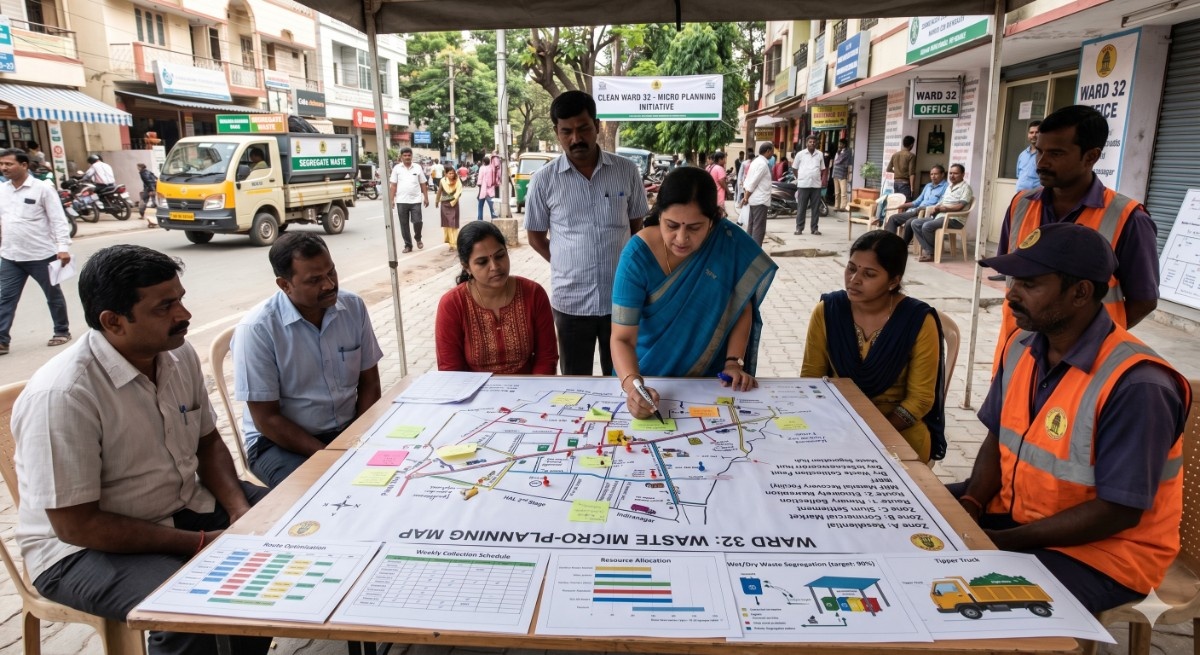
Again Resource Labs is currently developing a ward-level waste intelligence methodology — building a participatory micro-planning and traceability approach in partnership with a corporation partner in one ward, with the explicit goal of producing an open, replicable toolkit that other wards can adopt independently.
The methodology combines open geospatial data, building-level waste classification, field ground-truthing with pourakarmika supervisors and citizen groups, and lightweight tracking technology to measure whether a micro-plan is actually being followed once deployed. The goal is not just a better-functioning pilot ward — it is a shared methodology that becomes part of how corporations think about collection contracts.
Bengaluru will not solve its waste problem through goodwill and enforcement alone. It will solve it ward by ward, map by map, route by route — starting with the discipline of knowing what is actually there, who lives there, and when they need to be served.
Again Resource Labs is working on ward-level waste intelligence and micro-planning methodologies in Bengaluru. This piece is part of an ongoing series on urban waste systems in Indian cities.