
How We Support You
We help cities plan and implement practical circular infrastructure solutions — from the first brief through to on-ground delivery and compliance reporting.

Perspectives on SWM
Six perspectives on urban solid waste management for city planners, engineers, and commissioners — on where SWM policy and ground reality diverge, and what to do differently as a result.
 SWM
SWM
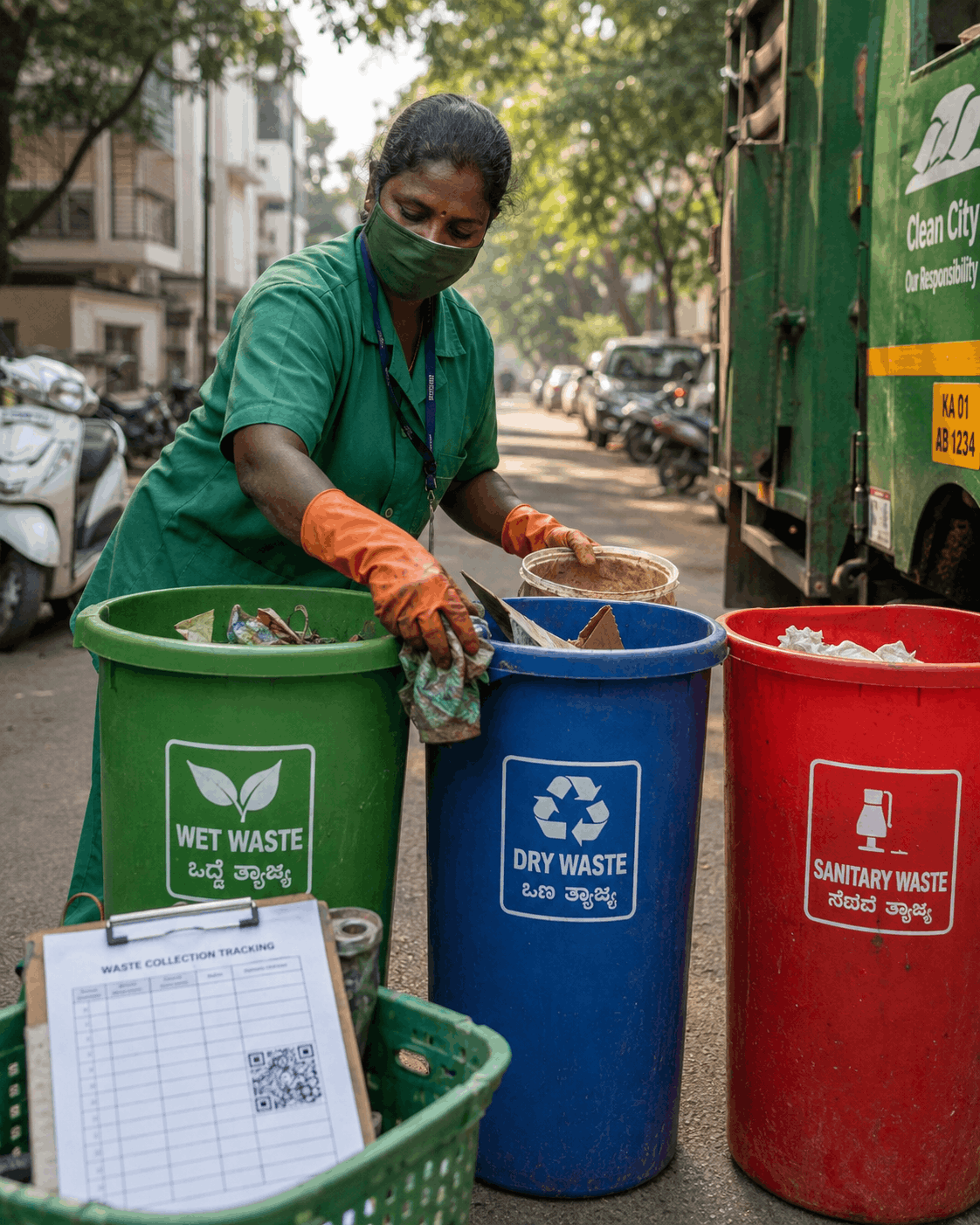
The Two Broken ChainsWhy Segregation Fails at Collection and Documentation
 SWM
SWM
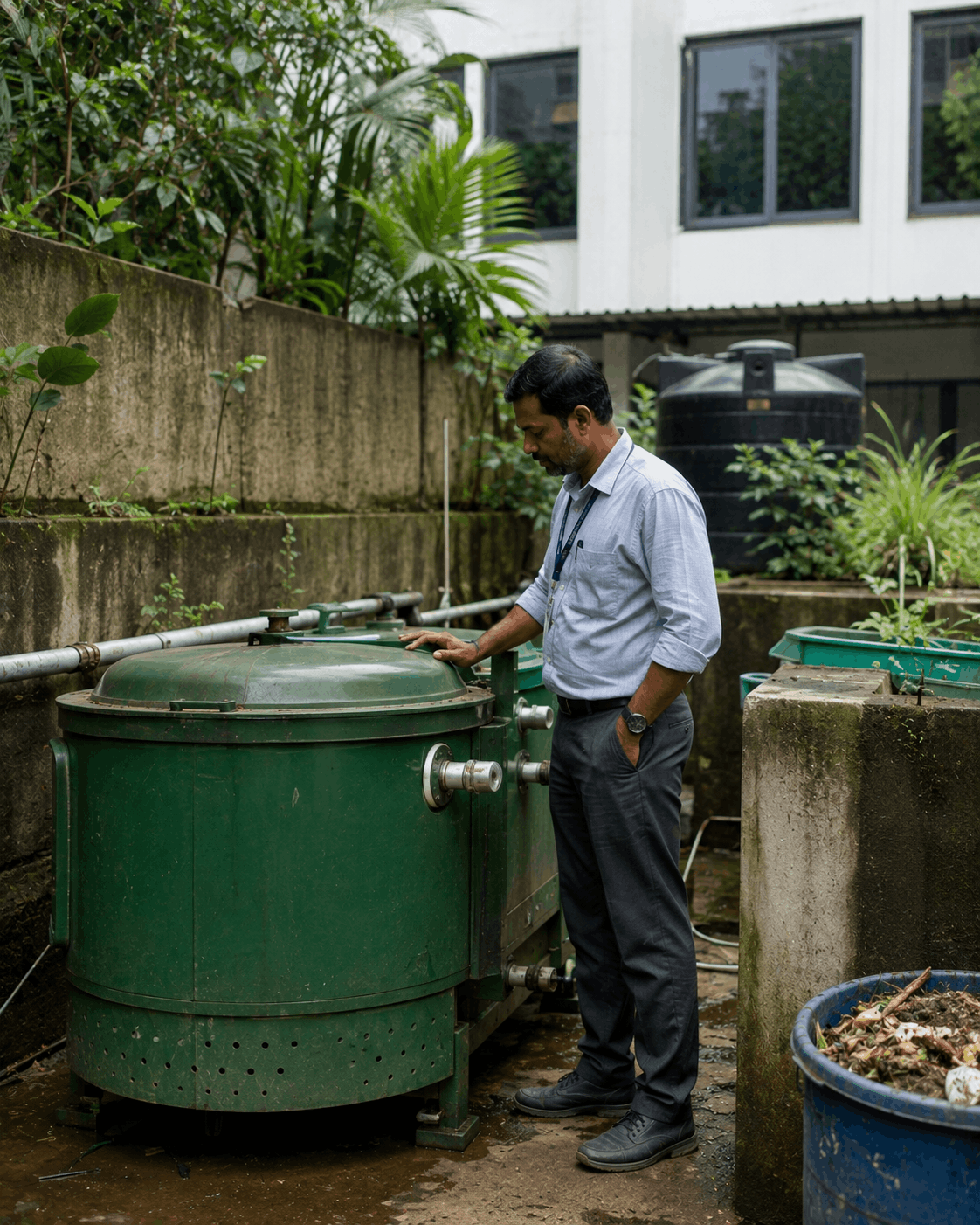
Beyond EnforcementThe Spatial and Economic Barriers to BWG Compliance
 SWM
SWM
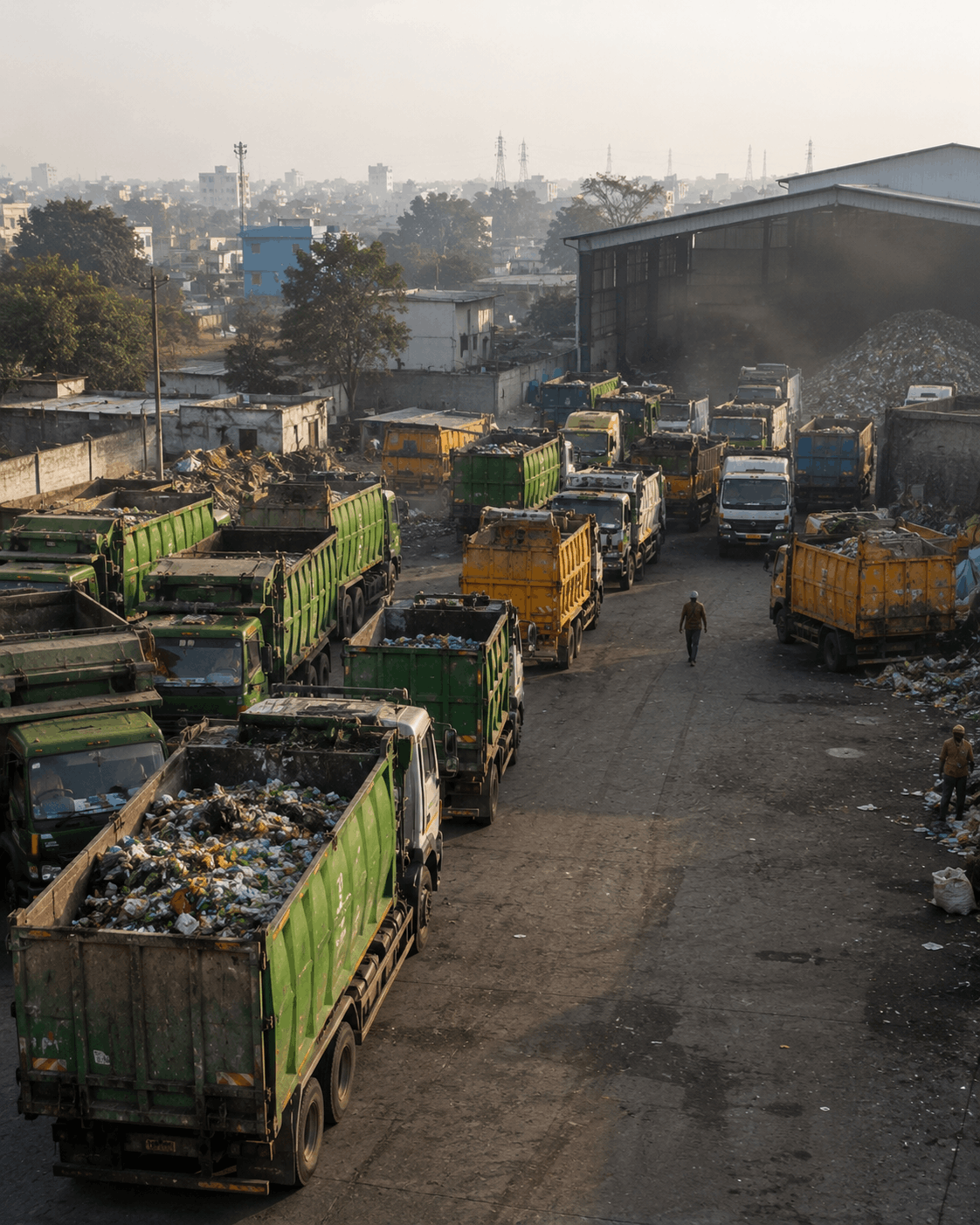
The Secondary BlindspotWhy Route Optimisation Fails at the Transfer Station
 SWM
SWM
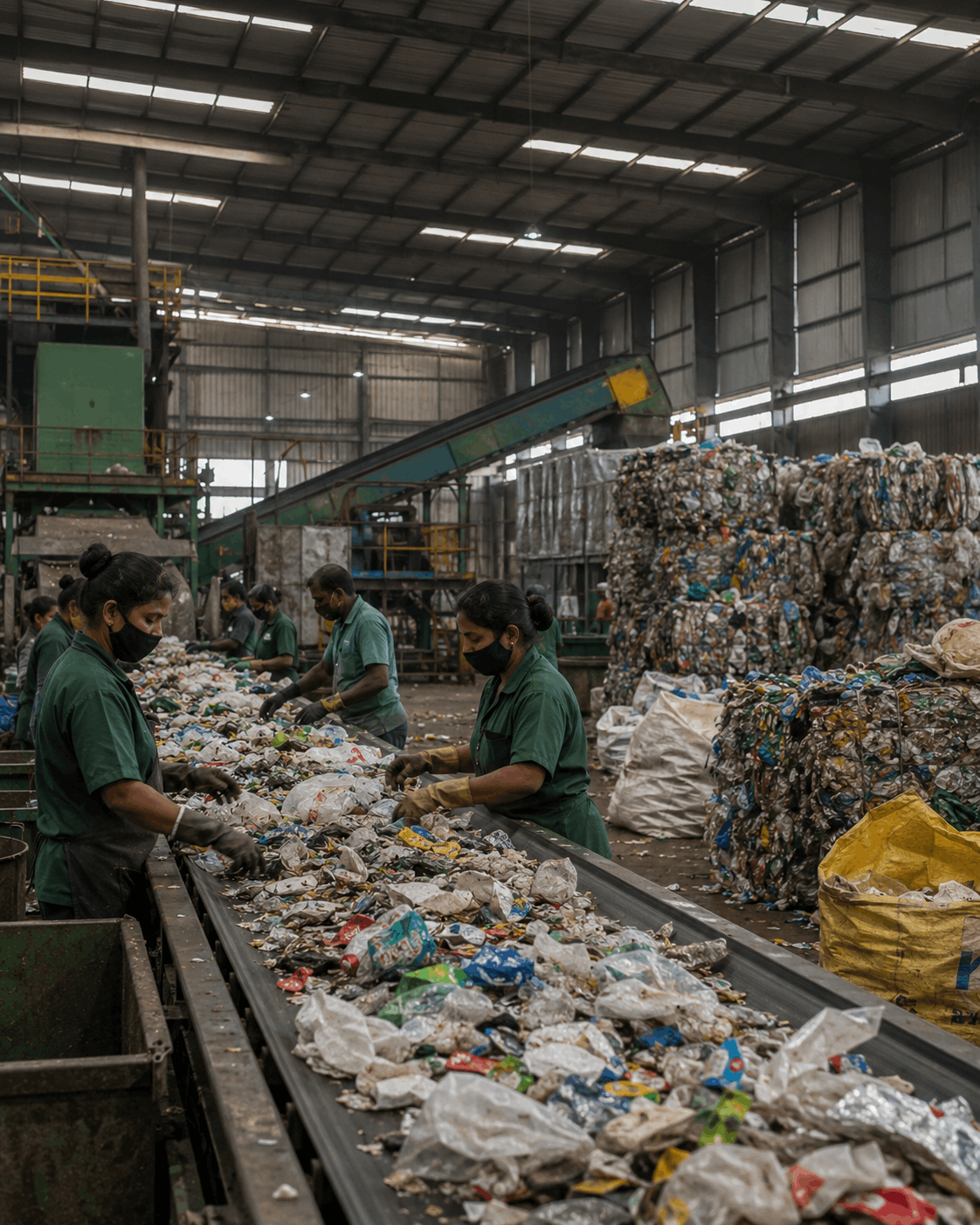
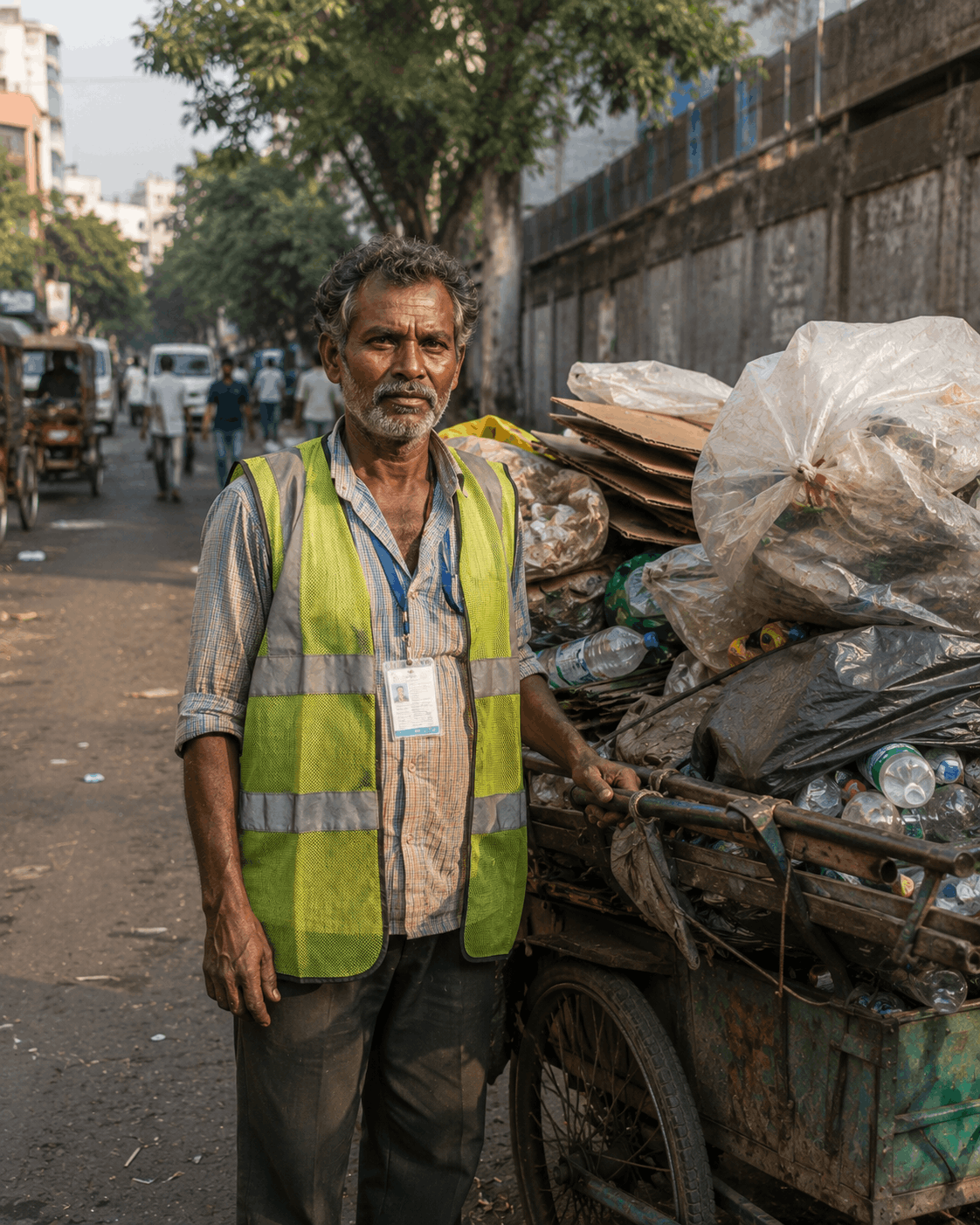
Capacity Without a BuyerThe Market-Design Flaw in Delayed Landfilling
 SWM
SWM
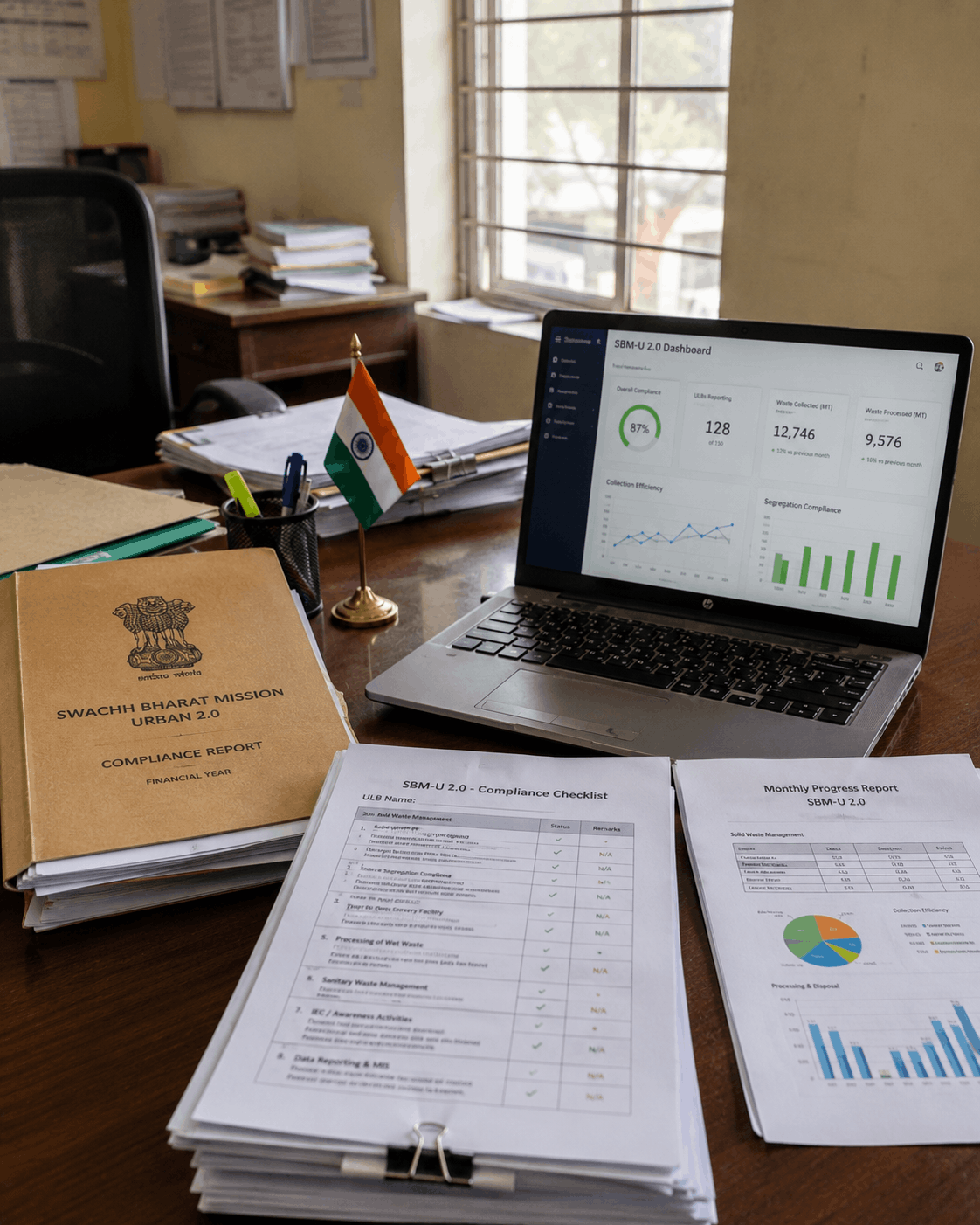
Absorb, Don't ReplaceWhy Displacement Guarantees Informal Formalisation Fails
 SWM
SWM
The Documentation GateAligning SWM Compliance, Scoring, and SBM-U 2.0 Funding
SWM Rules 2026 mandates four-stream segregation at source — wet, dry, sanitary, and special care waste. Compliance depends on two things holding simultaneously: citizens need to be convinced it matters, and the system needs to prove to them that it does. Cities that invest in citizen engagement alone, without fixing the collection chain behind it, are training households to do work that gets undone within the hour.
There is a revenue dimension most ULBs are not yet capturing. Segregated dry waste, properly processed and documented, is what makes material eligible against Extended Producer Responsibility obligations. The chain has two break-points, not one: the physical chain breaks when collection remixes the waste, and the financial chain breaks when documentation is insufficient to satisfy EPR auditors.
Cities should treat the documentation architecture with the same operational seriousness they give to fleet management and IEC, because it is the documentation that converts sorted waste into a credit that producers must pay against.
Many bulk waste generators genuinely intend to comply with on-site processing requirements — but the barriers are structurally different from one another, and no single policy lever addresses all three. The first is physical: many BWGs lack the space to install composting or biogas infrastructure. The second is economic: where informal, low-cost collection remains available, formal processing investment is not the rational choice. The third is regulatory: a hotel, a wholesale market, and an educational institution are routinely handed the same compliance pathway.
Enforcement-only strategies address none of these three constraints directly. Treating these as a single "compliance problem" misdiagnoses what is actually a site-planning problem, a micro-economics problem, and a policy-design problem wearing the same language.
A durable response deploys three levers: shared-processing zoning variances for the spatial barrier, cost offsets and differentiated fee structures for the economic barrier, and differentiated compliance pathways by generator type for the regulatory barrier.
Most route-efficiency efforts focus entirely on primary collection — household to transfer station — treating what happens after as a fixed, unexamined given. But secondary transport carries its own routing problem, often larger in distance and cost per tonne than primary collection, and hazardous or biomedical waste cannot be routed through the same secondary chain.
Field engineers directly cite insufficient secondary transfer infrastructure as a root-cause constraint on collection performance. Optimising primary routes against a static, poorly sited transfer station creates downstream congestion that backs up the very fleet being streamlined — degrading primary efficiencies through a feedback loop that sequential modelling cannot detect.
Route optimisation is genuinely two problems that must be modelled together — household to transfer station, and transfer station onward to the correct processing destination for each waste stream.
Cities that succeed at source segregation often still landfill most of what gets separated, because DWCC and MRF capacity was approved as a planning checkbox rather than sized against actual ward-level generation data. In under-planned circles, roughly three-quarters of collected waste can end up going directly to landfill purely from a shortage of processing infrastructure.
Even where land exists, what is frequently missing is a viable materials value chain — identified buyers, agreed rates, and workable logistics — that makes the facility financially sustainable to operate. Even a well-designed MRF generates residue that cannot be recovered, and what happens to that fraction is part of genuine diversion planning.
No civil detailed project report should be approved without an attached, signed letter of intent from local recyclers, and a binding contract for the disposal of non-recoverable residue.
A functioning recovery chain already exists in most cities before any formal system is designed — rag pickers to kabadiwalas to traders to recyclers, often operating with real efficiency at extracting recoverable material before it reaches a landfill. Formalisation efforts frequently fail not because informal workers resist regulation, but because the systems designed around them are built to replace this existing workforce rather than absorb it.
Participation in formalisation programmes stays low wherever the formal system offers legitimacy without preserving what workers already have. If formalisation is designed as displacement, cities drive away their most efficient recovery workforce while failing worker welfare and safety criteria that are increasingly scored in municipal evaluation.
Integration into the primary collection and MRF chain is the lower-risk alternative — not a guarantee of success, but the only design that doesn't guarantee a loss.
SWM Rules 2026 sets out specific, checkable obligations across the entire waste chain — four-stream segregation, Extended BWG Responsibility, door-to-door collection coverage, landfill diversion targets, a named residue protocol. Every one is auditable against a specific number or record, not a description of intent.
A large share of SBM-Urban 2.0-eligible activity is often already happening at ward level, yet funding applications stall because eligibility criteria are documentation criteria, not infrastructure criteria — a documented baseline, a stated measurable target, a monitoring plan, capacity sized against real generation data.
Compliance, Swachh Survekshan scoring, and SBM-U 2.0 funding eligibility share a common evidence base, and can be aligned into a single documentation exercise if built with that intent from the start.
Policy & Regulatory Insights

Solid Waste Management
Practical insights into on-ground implementation challenges and solutions for urban local bodies.
Read Brief
Lake Rejuvenation
Key insights from sustaining long-term ecosystem restoration initiatives successfully.
Read Brief
Rainwater Harvesting for Flood Mitigation
Integrating RWH into urban infrastructure to reduce flooding risks and build resilience.
Read Brief
Micro Planning for Urban Systems
Structured approach to planning at ward and city levels for scalable, bankable outcomes.
Read Brief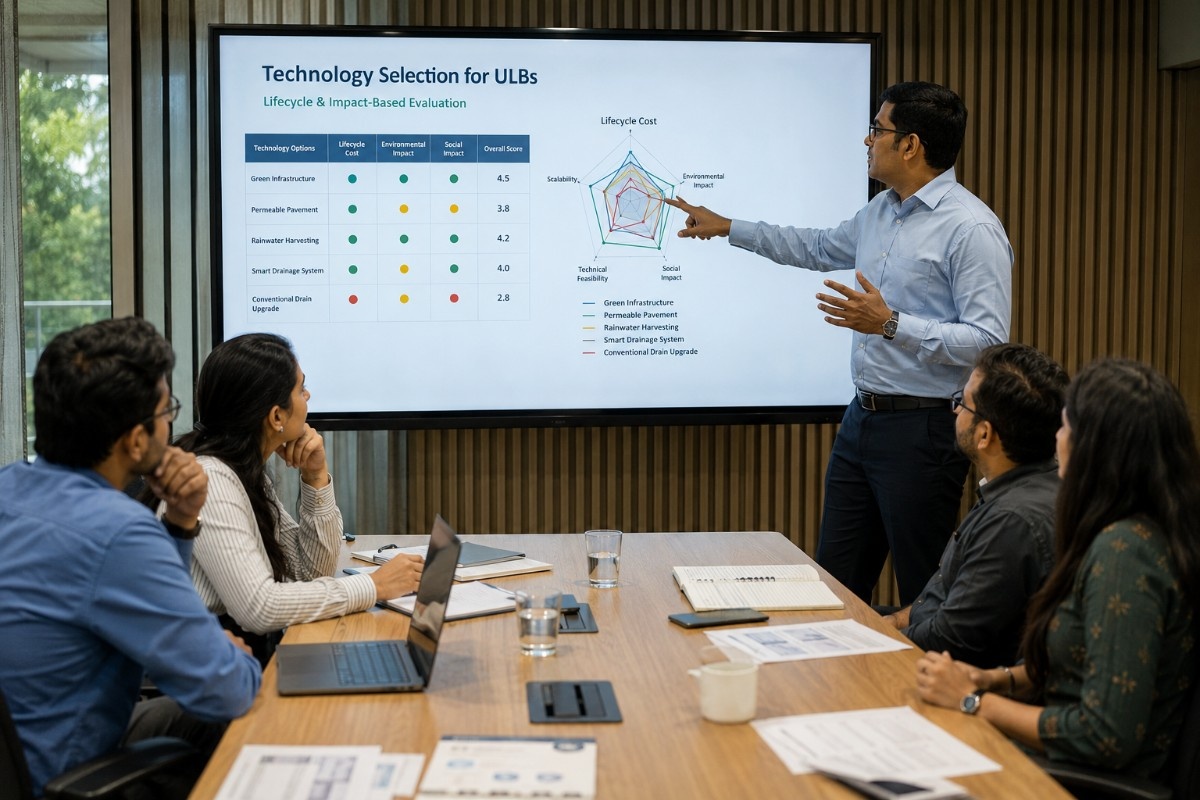
Technology Selection for ULBs
Choosing the right solutions using lifecycle and impact-based evaluation frameworks.
Read Brief