
From Bin to Burner
The Case for Decentralised Biogas in Bengaluru's Apartments
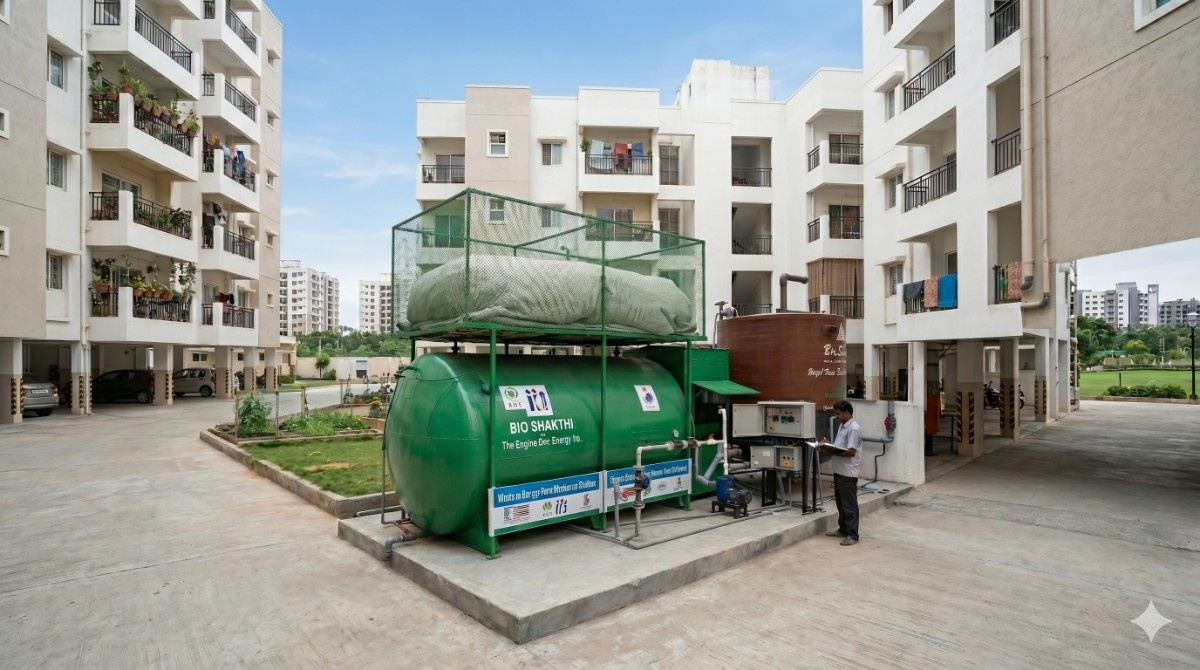
Every morning, hundreds of apartment complexes across Bengaluru load wet kitchen waste onto collection vehicles headed for landfills or centralised processing plants that are, by most accounts, already full or not operating optimally. Decentralised biogas provides a solution to that – and also generating energy and lower quantum of slurry, compared to composting. The technology is straightforward: organic wet waste — vegetable peels, food scraps, kitchen leftovers — is fed into a sealed anaerobic digester installed on the premises. Microorganisms break down the material over 15 to 20 days, producing methane-rich biogas that can be piped directly to a burner, and a nutrient-rich biofertiliser that works in the complex’s own landscaping or can be sold to nearby farms.
The numbers are more tangible than most committees expect: A 100-flat apartment generating 100 kg of wet waste daily can produce the equivalent of 7 to 11 LPG cylinders every month — from a footprint no larger than a mid-size storeroom. A 500-flat complex can do significantly better.
Request a Consultation
Section 01
How the process actually works
A well-designed system has four stages. Incoming waste is first received and shredded into a uniform slurry – this is where sorting matters, because plastic, glass, and packaging must be removed before anything enters the digester. The slurry is then fed into the main digester tank, a sealed vessel where a carefully maintained colony of anaerobic microorganisms does the conversion work.
The process runs at mesophilic temperatures (roughly 35–40°C) and takes between 15 and 20 days from input to output – significantly faster than composting, which can take two to three months. Gas produced is collected, cleaned of moisture and hydrogen sulphide, and stored in a low-pressure bladder before being piped to the point of use. The remaining digestate is dewatered into solid biomanure and a liquid effluent that can be used for gardening or safely drained.
Modern systems are largely automated – sensors monitor pH, temperature, and gas production continuously, with alerts sent remotely if any parameter drifts. The biological process is self-sustaining once established, requiring periodic maintenance rather than daily intervention.
Section 02
Common misunderstandings & real risks
The most persistent misconception is that biogas plants smell. A properly sealed, well-operated system produces no perceptible odour at the boundary — the anaerobic process is contained, and biological based odour control handles the waste receiving area. The smell association comes largely from poorly designed or neglected open-pit digesters, which are a different category of system entirely.
The second misunderstanding is that biogas is uniquely dangerous. Methane is flammable, but so is LPG, which apartment kitchens already use daily. It is less flammable and denser than LPG. Properly designed systems include pressure relief valves, automated shutoffs, gas sensors, and remote monitoring. The risk profile is comparable to any other piped gas installation and is managed with the same standard precautions.
The genuine risks are more operational than dramatic. Segregation discipline among residents is the most common failure point — not equipment. Biological systems also take time to establish: a new digester takes four to six weeks to reach stable gas production as the microbial culture matures, and committees that expect immediate output are often disappointed. Seasonal variations in kitchen waste composition can affect gas yield. And like any mechanical system, pumps, shredders, and sensors require periodic servicing — O&M arrangements must be factored into the operating plan from the start, not treated as an afterthought.
Section 03
Why decentralised systems matter now
What makes decentralised systems particularly relevant right now is the regulatory shift underway. BSWML’s bulk generator rules are closing the era of subsidised municipal pickup for large residential complexes. The question is no longer whether in-situ waste processing makes sense — it is which technology, which scale, and which operating model fits each complex’s specific situation.
Again Resource Labs works with apartment associations, RWAs, and facility managers to answer exactly those questions — starting with a simple waste and energy audit that tells you what your complex can realistically generate, what it will displace, and what the path to implementation looks like.
The waste leaving your gate every morning has value. It is worth finding out how much.